
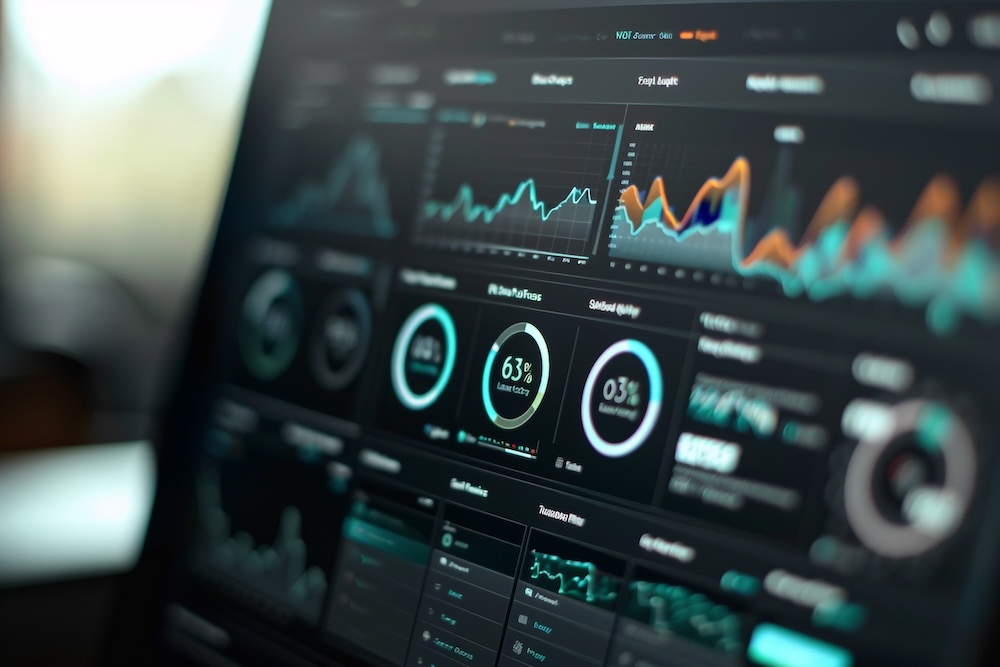
Businesses generate vast volumes of information every day, from sales numbers and customer behavior to supply-chain metrics and website interactions. But raw data alone is rarely helpful. That’s where BI dashboards (Business Intelligence dashboards) come in. These dashboards, often built and maintained by a trusted technology partner, use visual tools to turn complex business data into intuitive, actionable insights.

What is a BI Dashboard?
A BI dashboard is essentially a data visualization tool that consolidates information from multiple sources (CRM systems, sales platforms, databases, marketing tools, and more) and displays key metrics, trends, and KPIs all in one place. Rather than digging through spreadsheets or scattered reports, decision-makers get a clear snapshot of business performance at a glance: metrics like sales volume, customer acquisition, operational efficiency, or inventory levels.
These dashboards present data through charts, graphs, tables, heat maps, and other visuals, making complex datasets more understandable and digestible.
Why BI Dashboards Matter
BI dashboards centralize data in a way that supports real-time insights and quick decision-making. With dashboards, businesses can monitor key indicators like sales trends, customer behavior, supply-chain performance, and rapidly react to changes or anomalies.
Moreover, dashboards democratize data access. Rather than restricting insights to analysts or data scientists, dashboards enable managers, team leads, and even frontline staff to view and interpret business metrics, lowering the barrier for data-driven decisions across the organization.
The Role of Analytics & AI
What distinguishes modern BI dashboards from earlier “static reports” is the integration of analytics and, increasingly, AI. These aren’t just platforms that show what happened yesterday or last quarter. Many now provide real-time analytics, predictive insights, and even automated recommendations.
AI-enhanced dashboards can use machine learning and statistical modeling to forecast future trends, whether it’s predicting sales growth, customer churn, inventory demand, or operational bottlenecks. That predictive layer turns data from reactive to proactive.
Some systems embed augmented analytics: natural language querying, easy-to-interpret suggestions, and intuitive dashboards so users without deep technical skills can explore data and surface insights.
These AI-powered dashboards help businesses not only understand what happened, but why it happened, and what might happen next.

What a Good Technology Partner Brings
If you outsource your BI build, having a capable technology partner is key. A partner experienced in BI software development can:
- Integrate data from multiple sources (databases, data warehouses, cloud storage, CRM/ERP, etc.) into a unified platform.
- Build interactive dashboards tailored to your business metrics and workflows.
- Implement data pipelines and ETL (extract, transform, load) processes to ensure data consistency and reliability.
- Layer in analytics, including predictive models, trend analysis, and AI-powered insights.
- Provide ongoing support, maintenance, and customization so dashboards evolve with your business needs.
For example, a firm offering “AI-powered BI solutions” might deliver custom dashboards, predictive analytics, real-time data streaming, and integration with various data storage and processing technologies, ensuring your dashboards stay robust and flexible as your data grows.
Best Practices for BI Dashboards
To get the most value from BI dashboards:
- Start by defining your business objectives: Decide which KPIs matter most.
- Keep dashboards clean and focused: Overloading dashboards with too many metrics or visuals can overwhelm users; prioritize clarity and action-oriented insights.
- Enable interactivity: Good dashboards let users drill down, filter data, explore by time, region, product — giving deeper context when needed.
- Ensure real-time or near-real-time updates: The faster the data updates, the faster decisions can be made.
- Leverage analytics and AI thoughtfully: Use predictive capabilities, automated insights, and natural-language querying, but ensure transparency and interpretability of results.
- Iterate and evolve: As business needs shift, dashboards should be refined, restructured, or expanded to stay relevant.
Turning Data Into Decisions
BI dashboards, especially when enhanced with analytics and AI, offer an indispensable way for businesses to convert raw data into meaningful, actionable intelligence. By pulling together data from disparate sources, visualizing key metrics, and enabling real-time and predictive insights, dashboards empower teams to make faster, smarter, data-driven decisions.
Partnering with a technology provider who understands both data infrastructure and analytics can make the difference between a cluttered report overload and a streamlined, insight-driven BI solution. With BI dashboards, businesses gain clarity, agility, and a strategic edge: everything they need to stay ahead in a complex, data-rich world.
About ACT
Applied Computer Technologies (ACT) is a full-service IT provider, specializing in Reinsurance and Finance. Services include Cloud Services, IT Services and Support, Microsoft 365 and Azure Services, Business Continuity, Telephony and Virtual CIO Services. ACT has locations in Bermuda, Cayman Islands and Canada, with customers worldwide.
For the latest industry trends and technology insights visit ACT’s main Blog page.